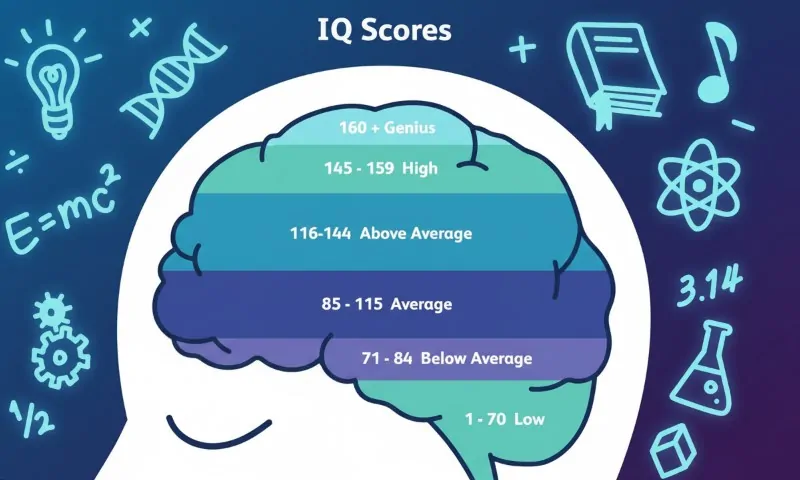
Few topics in popular psychology generate as much interest — and as much confusion — as intelligence testing. The phrase "IQ test" appears regularly in everyday conversation, in news coverage, and across the internet, yet many people have only a vague sense of what these assessments actually involve, where they came from, and what their results genuinely indicate.
This article aims to offer a clear, balanced overview of IQ-style assessments: what they were originally designed to measure, the types of tasks they typically include, the debates surrounding their limitations, and how results from informal online quizzes compare to formally administered tests.
A Brief History
The history of standardised intelligence testing begins in early twentieth-century France. In 1905, Alfred Binet and Théodore Simon developed a scale intended to identify children who might benefit from additional academic support. Their goal was practical and relatively modest — not to rank children by fixed ability, but to help educators provide better resources where needed.
The concept was later adapted and expanded, particularly in the United States, where Lewis Terman revised Binet's original scale and introduced the term "intelligence quotient," calculated by dividing a person's mental age score by their chronological age and multiplying by 100. This single number became enormously influential — and, in many respects, oversimplified.
Over the following decades, intelligence testing became common in educational, military, and occupational settings. Modern standardised tests — such as the Wechsler scales — are considerably more sophisticated than their early predecessors, incorporating multiple distinct subtests and providing composite scores rather than relying on a single number.
What IQ-Style Tests Typically Measure
Contemporary IQ-style assessments generally evaluate several distinct cognitive capacities. Understanding these components helps demystify what these tests actually examine.
Verbal Comprehension
This dimension involves vocabulary knowledge, the ability to understand and explain abstract concepts, and verbal reasoning tasks. Questions might ask participants to identify relationships between words, complete analogies, or explain the meaning of terms in context.
Working Memory
Working memory tasks assess how well a person can hold and manipulate information in the short term. Common examples include repeating sequences of numbers forwards and backwards, or mentally tracking multiple pieces of information simultaneously.
Processing Speed
These tasks evaluate how quickly and accurately a person can process simple visual information. Speed-oriented subtests often involve matching symbols, identifying patterns, or completing visual searches within time limits.
Fluid Reasoning
Fluid reasoning — sometimes considered the core of what intelligence tests measure — involves identifying patterns, drawing logical conclusions from incomplete information, and solving novel problems without relying on prior knowledge. Matrix reasoning tasks, where participants select the missing piece in a visual pattern, are a well-known example.
What IQ Scores Do and Don't Tell You
A key point worth emphasising is that IQ scores represent performance on a specific set of tasks, administered under specific conditions, at a specific point in time. They are not fixed, immutable measures of a person's intellectual capacity.
IQ scores represent a snapshot of reasoning performance — not a permanent, all-encompassing measure of a person's intellectual potential.
Several well-established observations should shape how we interpret these scores responsibly:
- Scores are not fixed. Research consistently shows that scores can change over time, are influenced by factors such as education, health, stress, and familiarity with testing formats.
- Tests measure only some aspects of cognition. Creativity, emotional intelligence, interpersonal skill, practical wisdom, and domain-specific knowledge are all examples of valued human capacities that standard IQ-style tests do not meaningfully assess.
- Cultural and contextual factors matter. Researchers have long documented ways in which test design, language, and familiarity with standardised testing formats can influence results. These are important considerations in interpreting group-level data particularly.
- Formal and informal tests differ considerably. Standardised intelligence assessments administered by qualified professionals follow strict protocols, are normed on large representative samples, and yield results with established reliability and validity. Online quizzes — including those on entertainment-focused platforms — do not meet these standards and should be understood accordingly.
Informal Online Quizzes: A Different Category
It's worth being direct about how informal online IQ-style quizzes differ from professionally administered assessments. Online quizzes — including the reasoning challenges on this platform — are designed for educational exploration and entertainment. They do not carry the psychometric rigour of standardised tests, are not administered under controlled conditions, and have not been normed on representative populations.
That does not make them without value. Well-constructed online quizzes can expose participants to interesting reasoning tasks, encourage reflective thinking, and prompt people to explore educational resources about how cognition works. The key is interpreting them accurately: as structured exercises, not as definitive measures of ability.
The Value of Approaching Reasoning Challenges with Curiosity
One consistent finding in cognitive research is that engaging regularly with reasoning tasks — puzzles, logical challenges, reading, learning new skills — is associated with maintained cognitive vitality over time. While no single quiz or activity is guaranteed to produce measurable changes in ability, the habit of intellectual engagement is broadly considered beneficial.
More importantly, approaching these challenges with a spirit of curiosity rather than a focus on scores tends to produce better learning outcomes. When the goal is to understand why an answer is correct — rather than simply to get it right — the educational value of the exercise increases substantially.
A Responsible Perspective on Assessment
The most measured conclusion about IQ-style testing is this: these assessments are useful tools with meaningful but limited applications. For specific professional purposes — learning support assessment, occupational evaluation, neuropsychological evaluation — formal standardised tests administered by qualified professionals have an established role. For general curiosity, structured online quizzes can be an engaging way to encounter and explore reasoning concepts — provided results are understood as descriptive and informal rather than diagnostic or definitive.
If you are curious about your own cognitive profile or have questions related to learning, memory, or attention, consulting a qualified psychologist or educational specialist is always the appropriate path. Online quizzes, at their best, are a starting point for curiosity — not a conclusion.